

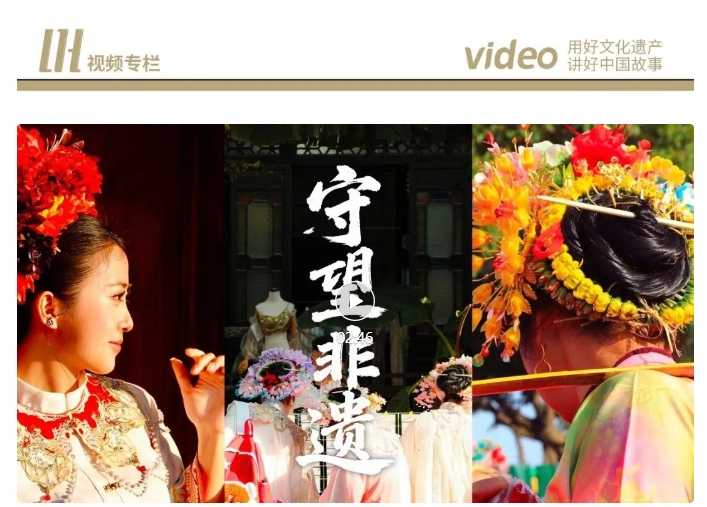
Intangible Cultural Heritage - Crab Pond Hairpin Flower
This issue of the "Watch for Intangible Cultural Heritage" program will focus on a long-standing but still popular hair accessory art - Quanzhou Crab Pond Hairpin Flower. The sea breeze is thousands of miles away, it's better to wear hairpins all year round than to have flowers blooming. "The hairpin flower in Xunpu, Quanzhou, carries the deep longing of Quanzhou people for a better life. It is the crystallization of local women's wisdom and a symbol of Quanzhou culture. As early as 2008, the "Xianpu Women's Customs" were included in the national level intangible cultural heritage protection project. Nowadays, tourists from all over the country and even abroad come here to experience this' flowing garden '.
Xunpu Village is located at the starting point of the ancient Maritime Silk Road and on the north bank of Quanzhou Port. This used to be the departure point for many ocean going merchant ships, with a history of nearly a thousand years. In the era of "rising seas amidst the sound of foreign merchants", countless overseas merchants settled here, bringing exotic cultures and clothing traditions. As early as the Tang Dynasty, people had the habit of decorating their hair buns with hairpin flowers; In the Song Dynasty, even men began to hairpin flowers. According to legend, the women's hairpin flower enclosure in Xunpu is closely related to the customs of Arabia and Central Asia during the Song and Yuan dynasties. The product of the fusion of Central Plains culture and maritime culture is adorned with floral headbands, long skirts, wide leg pants, and lilac pendants.
The technique of making hairpin and flower ornaments in Chuanpu, Quanzhou has been passed down for a long time and is known as the "ancient hair accessory art of the East". When combing hair accessories, first gently apply tea oil or aloe vera juice to the hair; Divide the hair into front and back parts with the ear tips as the boundary, tie the back half into a ponytail, and then comb the front half. Then twist the front and back hair into a strand, tie it with a red headband, spiral it into a concentric bun, and fix it with a 22-24 centimeter ivory comb. Next, the hairpin maker uses hemp thread to string fresh flower buds or buds into a wreath, ranging from one or two rings to six or seven rings, forming concentric circles around the hair bun. Insert a single bouquet of seasonal flowers, silk flowers, or plastic flowers around the periphery. Crab Pu women prefer bright colors such as red, yellow, pink, etc. Nowadays, with the arrival of tourists, the color scheme is even more unconventional.
In this life, hairpin flowers are beautiful, in the next life, "is a saying that has been passed down in Xunpu Village. For the women of Chupu, beauty is not just about their hair accessories and appearance, but also about their inner "beauty". On weekdays, they work hard and go out to sea to fish. They adorn their hairpins with flowers, adding color to their lives. On the 29th day of the first lunar month every year, the "Heavenly Fragrance Patrol" ceremony is held in Xunpu Village. The women of Xunpu dress up with flowers and respectfully welcome the Mazu sedan chair, praying for the safe return of their families who have been working at sea.
The sea breeze brushes gently, and thousands of flowers dance together. Regardless of age, the women of Xunpu continue their long-standing customs, carefully adorning themselves with colorful flowers, living seriously, and striving to live beautifully. As long as there are flowers blooming, life will not be associated with darkness, and life will become vibrant and colorful.
Regarding: Guarding Intangible Cultural Heritage
The new video program <<Watch for Intangible Cultural Heritage>> specially planned by the UNESCO Chair in the Inheritance and Innovation of World Traditional Handicrafts and the Cultural Heritage Creative Industry Research Institute of Jinan University has been officially launched. We have built a cultural bridge with Hong Kong's "China Tourism" magazine, introducing an intangible cultural heritage technique in each issue and using images to experience the warmth and power of traditional culture.
