

Guarding Intangible Heritage | Shadow Puppetr
Special Column

Author: Chen Ping
President of the International Organisation of Folk Art (IOV); holder of the UNESCO Chair on the Transmission and Innovation of World Traditional Handicrafts; Dean and Professor of the Institute for Cultural Heritage and Creative Industries, Jinan University; Editor-in-Chief of the Blue Book of Intangible Cultural Heritage: Development Report on China's Intangible Cultural Heritage.
Curator's Note: Shadow puppetry is a thousand-year-old story told between light and shadow, and a distinctive vessel of Chinese folk culture. Delicate as cicada wings, the puppets sway beneath the rays, seeming to rouse history and legend by degrees. Each puppet bears the artisan's devotion: the cut of every line, the stroke of every expression, the hue of every tint—all infused with the warmth of time and cultural feeling. What the audience perceives in the flicker of light and shadow is not merely the unfolding of a story, but also the resonance of craftsmanship and local tradition. Shadow puppetry preserves the bustle of festival temples, the subtlety of daily life, and the stories passed from generation to generation within the play of light and shadow. Whether recounting the heroic legends of famous tales or the joys and sorrows of ordinary folk, the art allows culture to flow between motion and stillness, enabling audiences to sense the depth and wisdom of local traditions. With every rise and fall of light and shadow, the artisan's heart speaks aloud—a reminder of those moments when folk heritage is rediscovered and cherished in modern life.
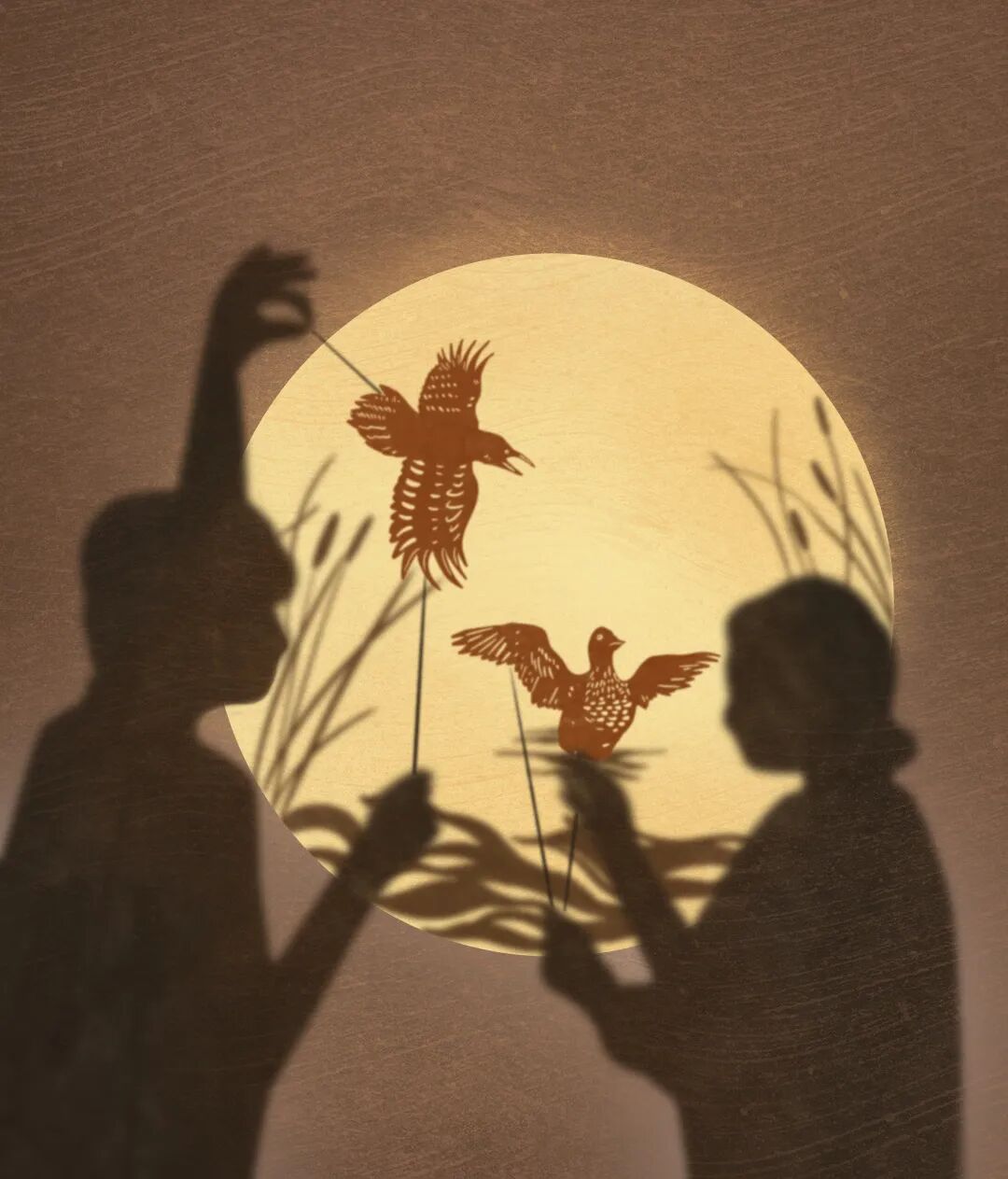
Performers animate the puppets amid light and shadow, giving rise to this singular theatrical art. (Visual China Group)
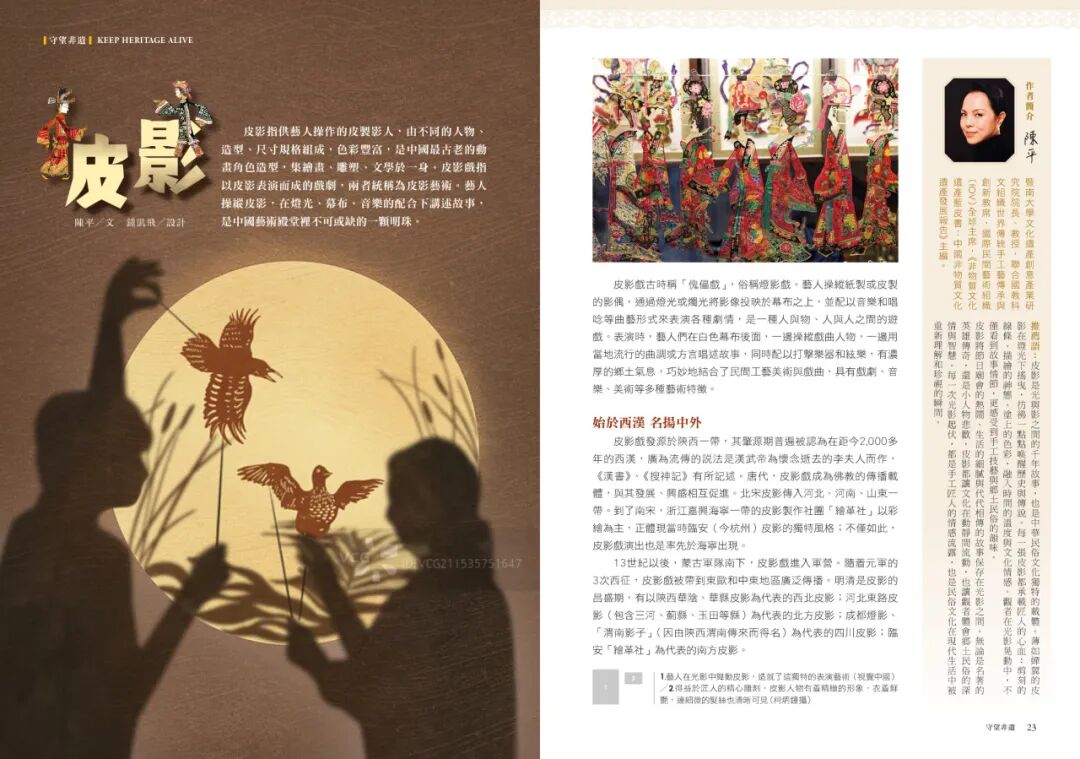
Shadow puppets refer to the leather figures manipulated by performers, comprising a variety of characters, forms, and sizes, rendered in rich colors. They represent China's oldest form of animated character design, uniting painting, sculpture, and literature within a single art. Shadow puppetry, the theatrical art performed with these figures—together with the puppets themselves—is collectively known as the art of shadow play. Through the coordination of puppets, lamplight, screen, and music, performers recount stories, making shadow puppetry an indispensable jewel within the hall of Chinese art.
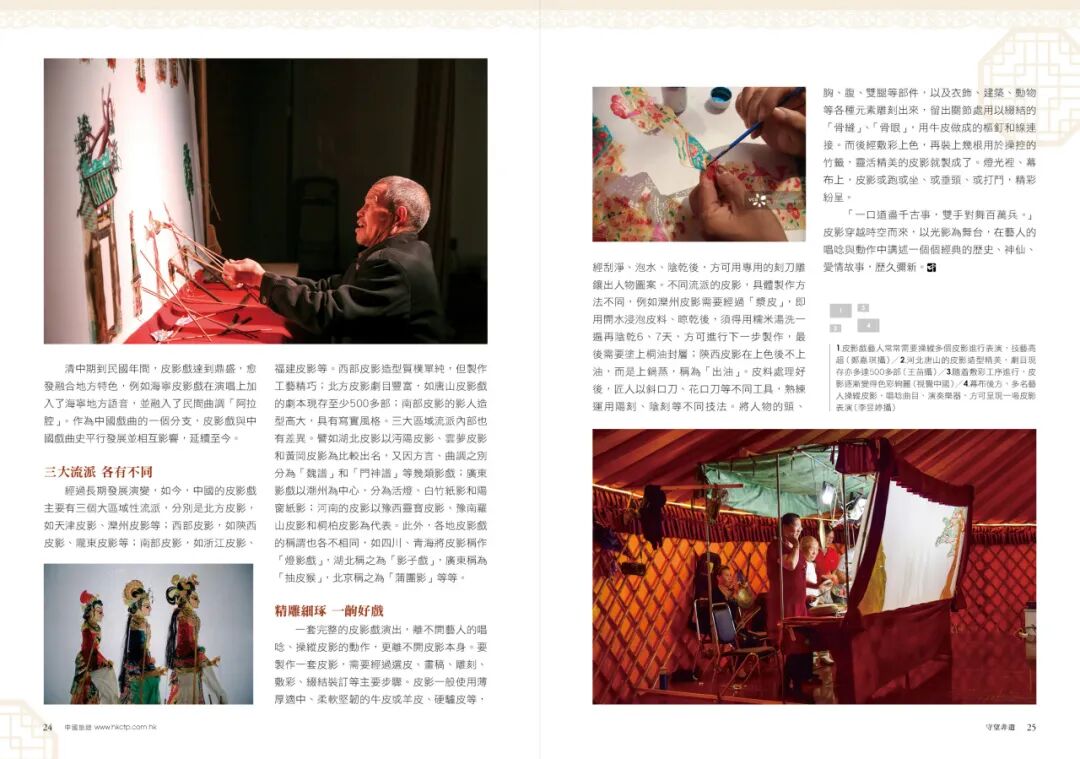
Shadow puppetry was known in ancient times as "puppet drama" and more colloquially as "lamp-shadow play." Practitioners manipulate paper or leather figures, casting their images onto a screen by lamplight or candlelight while recounting the tale through music, singing, and recitation; it is at once a play of hand and object, and of one performer with another. Onstage, the artists stand behind a white screen, controlling the characters as they sing the story in local tunes or dialect, accompanied by percussion and stringed instruments. Steeped in the breath of the soil, shadow puppetry ingeniously unites folk craft with theatrical performance; it carries the hallmarks of drama, music, and visual art alike.
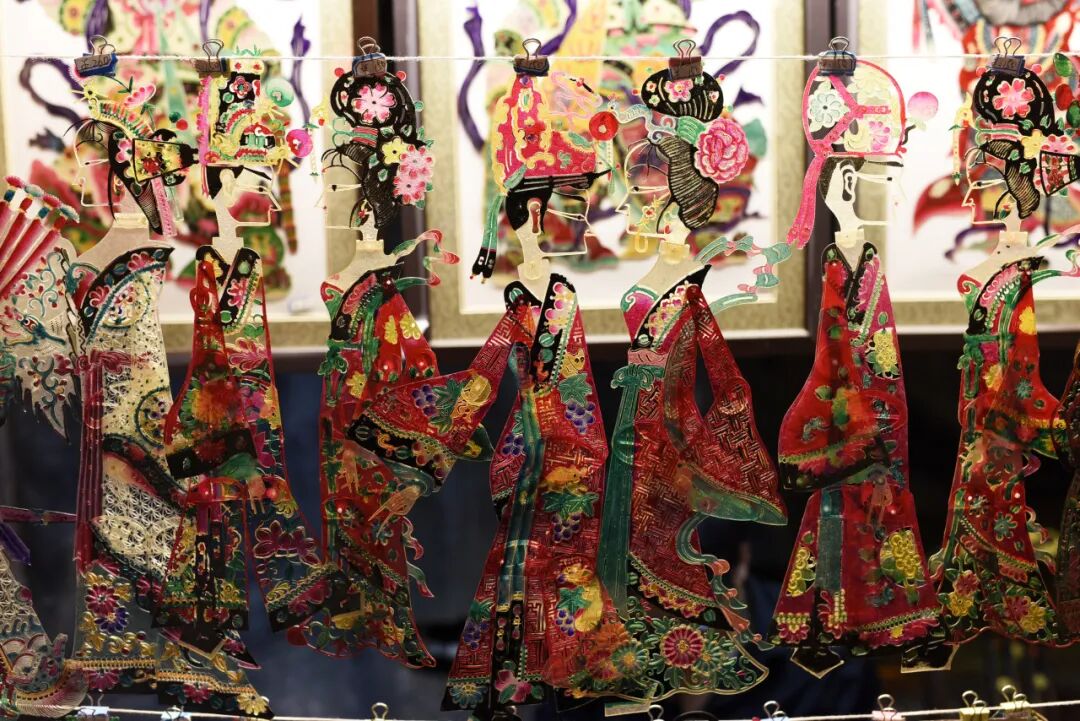
Thanks to the artisans' meticulous carving, the puppet figures possess refined features and vivid costumes, with even the finest strands of hair rendered with clarity. (Photograph by Ke Bingzhong)
From the Western Han Dynasty, famous to internationally
Shadow puppetry originated in the Shaanxi region. Its beginnings are generally placed in the Western Han dynasty, more than two thousand years ago. A widely circulated account holds that Emperor Wu of Han, pining for his late Consort Li, devised the art; both the Book of Han and the In Search of the Supernatural record it. In the Tang dynasty, shadow puppetry became a vehicle for the propagation of Buddhism, its development and flourishing advancing hand in hand with the faith. During the Northern Song, the art spread to Hebei, Henan, and Shandong. In the Southern Song, the puppet-making guild known as the "Huige Society" of Haining in Jiaxing, Zhejiang, favored painted puppets—a reflection of the distinctive style then prevailing in Lin'an (present-day Hangzhou). Notably, shadow puppetry performances are likewise recorded as first appearing in Haining.
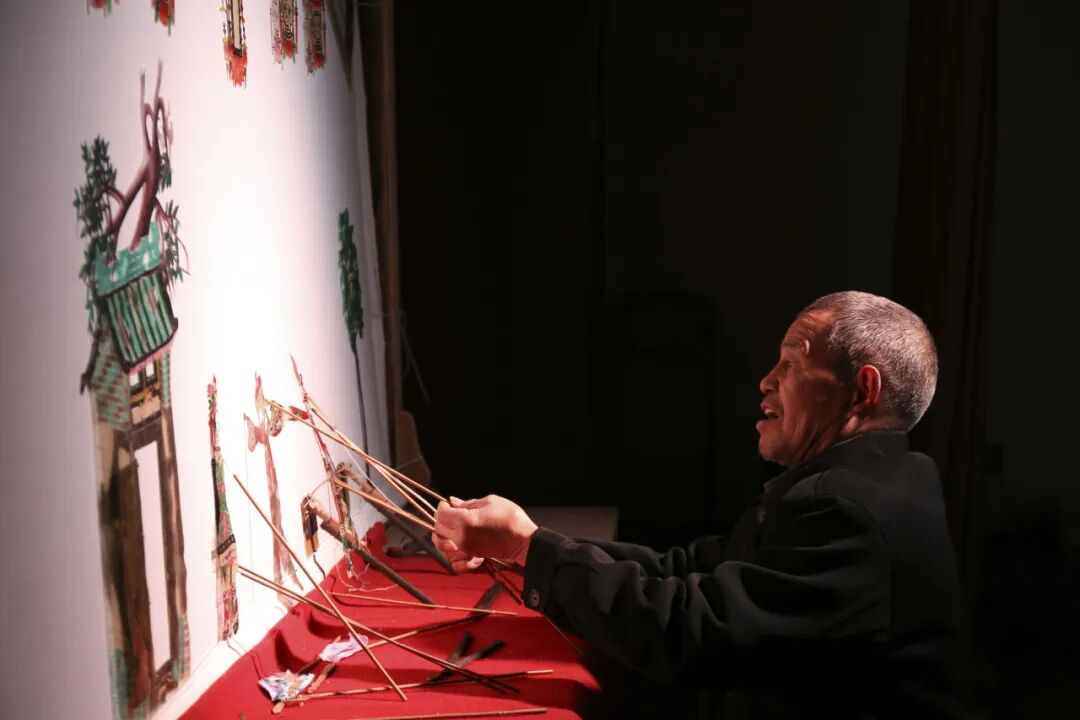
Shadow puppet performers are often called upon to handle several puppets simultaneously, a feat requiring consummate skill. (Photograph by Zheng Jiaqi)
From the thirteenth century onward, as the Mongol armies pushed south, shadow puppetry entered the military camps. With the three westward expeditions of the Yuan armies, the art was carried far into Eastern Europe and the Middle East. The Ming and Qing dynasties formed its golden age, witnessing the emergence of several regional traditions: the northwestern school, represented by the puppets of Huayin and Huaxian in Shaanxi; the northern school, represented by the eastern Hebei school (encompassing Sanhe, Jixian, Yutian, and surrounding counties); the Sichuan school, exemplified by the Chengdu "lamp-shadow" and the "Weinan shadows" (so called for having been brought from Weinan in Shaanxi); and the southern school, represented by Lin'an's "Huige Society."
From the mid-Qing through the Republican era, shadow puppetry reached its zenith, growing ever more deeply fused with local color. The Haining tradition, for instance, incorporated the local Haining dialect into its singing and wove in the folk tune known as "Alaqiang." As a branch of Chinese theater, shadow puppetry has developed in parallel with—and in dialogue with—the broader history of Chinese drama, a lineage that endures to this day.
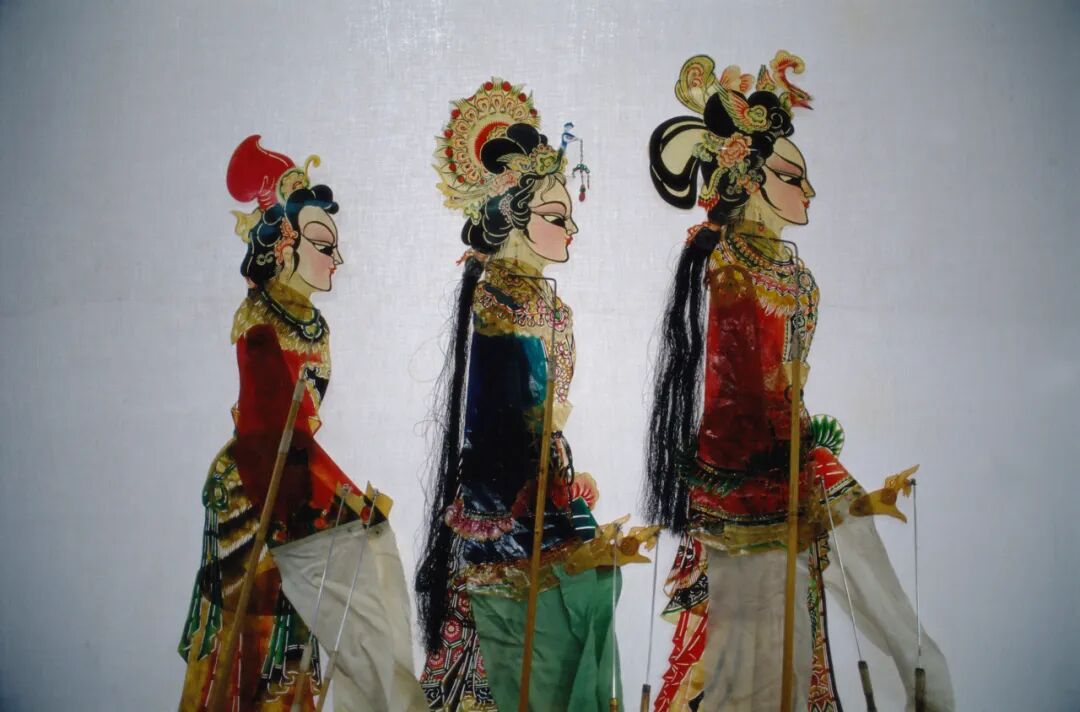
Tangshan in Hebei is renowned for its exquisite puppet designs, with more than five hundred play scripts still extant. (Photograph by Wang Miao)
Three great regional traditions
Through long evolution, shadow puppetry in China today comprises three great regional traditions: the northern school, including the Tianjin and Luanzhou traditions; the western school, encompassing the Shaanxi and Longdong traditions; and the southern school, including the Zhejiang and Fujian traditions. The western tradition is distinguished by its unadorned, simple forms combined with exquisite craftsmanship; the northern tradition boasts a rich repertoire—as seen in the Tangshan plays, of which at least five hundred scripts survive; and the southern tradition is marked by tall, realistically modeled figures. Within each of these three traditions, further distinctions arise. The Hubei tradition, for example, is best represented by the Mianyang, Yunmeng, and Huanggang schools, and is further subdivided by dialect and tune into such branches as the "Wei Pu" and "Menshen Pu." The Cantonese tradition, centered on Chaozhou, comprises the huodeng (live-lamp), baizhu-paper, and yangchang-paper variants. Henan's tradition is represented by the western Henan's Lingbao, southern Henan's Luoshan, and Tongbai schools. Beyond these, the very name of the art varies by region: Sichuan and Qinghai call it "lamp-shadow drama"; Hubei calls it "shadow drama"; Guangdong refers to it as "choupihou" (literally, "pulled-skin monkey"); and Beijing knows it as "putunying" ("cushion shadow"), among many others.
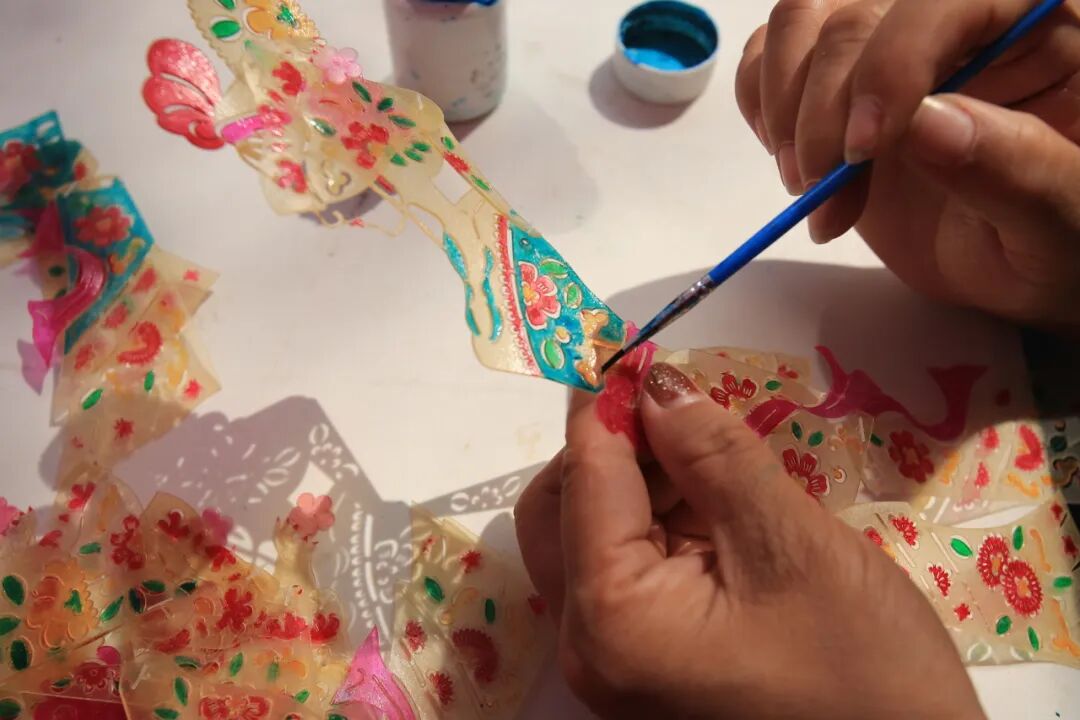
As the coloring process advances, the puppets gradually come alive with radiant hues. (Visual China Group)
Exquisite craftsmanship
A complete shadow puppet performance requires not only the performers' singing and recitation and the manipulation of the puppets, but also the puppets themselves. To produce a set of shadow puppets, one must pass through several principal stages: skin selection, pattern drawing, carving, coloring, and final assembly by stitching and jointing. The puppets are generally fashioned from cowhide, sheepskin, or hard donkey hide of moderate thickness—pliable yet strong. After scraping clean, soaking, and drying in the shade, the hide is ready to receive the figures carved out with specialized knives. The methods vary between traditions. In the Luanzhou school, for instance, the hide must undergo a "starching" process: after being steeped in boiling water and dried, it is washed with a rice-flour broth and left to dry in the shade for six or seven days before the next step can begin; finally, a layer of tung oil is applied as a sealant. The Shaanxi school, by contrast, omits the oiling step, instead steaming the colored puppet—a process known as "chuyou" (literally, "drawing out the oil"). Once the hide is prepared, the artisan wields a range of tools—oblique-edged knives, flower-mouth knives, and others—to render, in deft strokes of positive and negative carving, the puppet's head, chest, torso, and limbs, alongside costumes, architecture, animals, and other elements. Carved "bone-seams" and "bone-eyes" are left at the joints, to be linked with leather pivots and thread. After the application of color, control sticks of bamboo are fixed in place, and the flexible, exquisite puppet is complete. Under the lamplight, on the screen, the puppets may run or sit, bow their heads, or do battle—a vibrant spectacle.
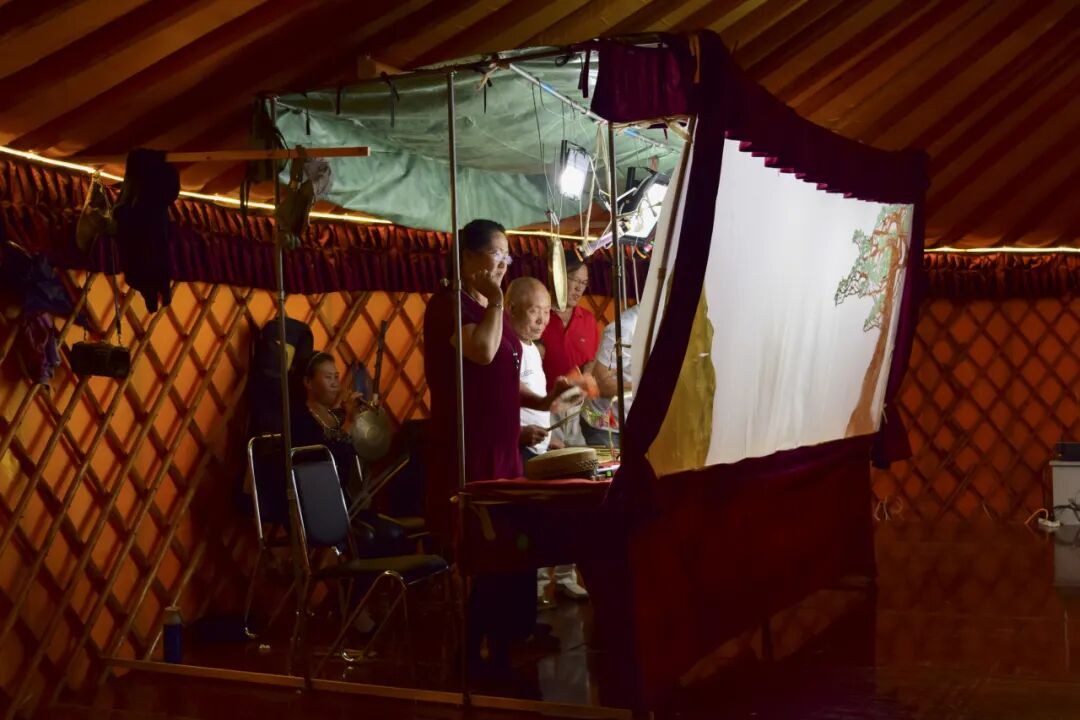
Behind the screen, a number of performers manipulate the puppets, recite the parts, and play the instruments, together conjuring a shadow puppet performance. (Photograph by Li Yuting)
"A single voice recounts the affairs of a thousand years; a pair of hands conjures forth a million warriors." Shadow puppetry has come down to us across the ages, taking light and shadow for its stage, and through the singers' voices and the puppets' gestures recounts one classic tale after another—of history, of immortals, of love—each as fresh as ever.
This article appears in Issue 4, 2026, of China Travel, a Hong Kong-based magazine.
《China Travel 》Magazine
With thanks to China Travel Magazine
A slender volume in hand, we invite you to travel together through the length and breadth of the land—across the rivers south of the Yangtze and the plains north of the Great Wall. Established in 1980, the China Travel Publishing House of Hong Kong founded the monthly magazine China Travel in July of that same year. With vivid photography and informative, lively prose, the magazine offers in-depth coverage of China's natural scenery, geography, folk traditions, historical sites, and cultural arts, and has won a devoted following among travelers and photography enthusiasts alike. Over the years, China Travel has uncovered and reported on many little-known landscapes and local customs. It will continue to lead its readers to witness the shifting scenes of the nation and to take in the splendor of its great rivers and mountains.
