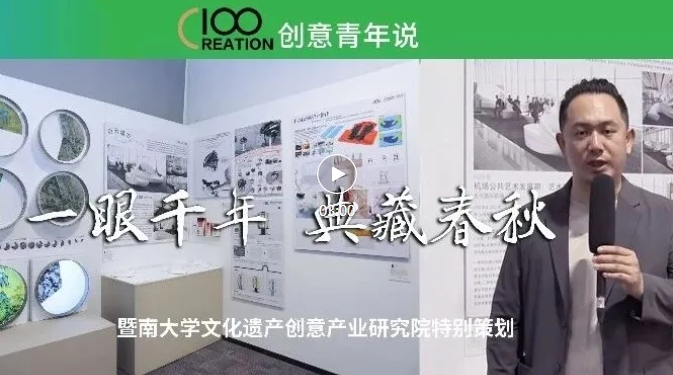
The four seasons are orderly, and a fan hides spring and autumn. The work 'A Thousand Years at a Glance' is an intangible cultural heritage dynamic clock inspired by folding fans. 24 fan bones represent 24 solar terms and 24 time indicators. On the fan surface, there flows a thousand year cultural heritage. Wang Ximeng's thousand mile kingdom and Huang Gongwang's Fuchun River bank overlap at this moment. As time goes by, when the mechanical gears drive the opening and closing of the fan bones, the wisdom of the millennium old agricultural civilization's solar terms meets modern design, and the "slow" of traditional handicrafts and the "fast" of clocks form a poetic dialogue. The opening and closing of a folding fan is not only a measure of time, but also a breath of culture.
Folding fans were introduced to China from Japan in the early Northern Song Dynasty and became popular during the Ming Dynasty. After being introduced to China, folding fans absorbed traditional Chinese ethnic culture and art, creating a unique Chinese folding fan with ethnic characteristics. 24 rotatable fan bones turn into time pointers, each corresponding to a solar term, slowly opening and closing over time, like a fan dancing in the breeze, or like the whispers of time.
This work was designed by Shao Xuguang, a teacher from the School of Urban Design at the Central Academy of Fine Arts and a member of the fifth batch of Creative 100 students. The two fan faces are respectively based on the charm of "Thousand Miles of Mountains and Rivers" and "Dwelling in Fuchun Mountains", with the traditional 24 solar terms of China as the soul, cleverly integrating the folding fan as a carrier of literary temperament and national characteristics. As one of the famous paintings passed down from generation to generation in China, "Dwelling in Fuchun Mountain" was painted by the famous Yuan Dynasty painter Huang Gongwang. It has changed hands several times and was also buried in two sections due to "burning paintings". At present, the first half of the "Remaining Mountain Map" is collected in the Zhejiang Provincial Museum, and the second half of the "Useless Teacher Scroll" is collected in the National Palace Museum in Taipei. Shao Xuguang used AI collage technology to merge the "Dwelling in the Fuchun Mountains" on both sides of the Tibetan Plateau into one. As time passed, the two paintings merged with the mountains and waters on the clock. He hopes that through this work, the inheritance of cross-strait culture and the concept of one family can be reflected. Fan open, the mountains and rivers are magnificent; Fanhe is a wish for reunion.
A thousand years at a glance, preserved in the Spring and Autumn period. Traditional culture is not a static heritage, but a constantly evolving present. In the era of rapid technological advancement, may we still be able to compose a gentle poem for time.
Regarding creative youth speaks:
The Cultural Heritage and Creative Industry Research Institute of Jinan University has launched a video program called "Creative Youth Talks", which will officially open in 2025. Through the first perspective of designers and inheritors, this article explores the cultural context and creative thinking behind the work, and explores the transformation path of traditional craftsmanship in contemporary contexts. Welcome to the "folk art heritage" official account for subscription. More exciting content is being updated continuously.