

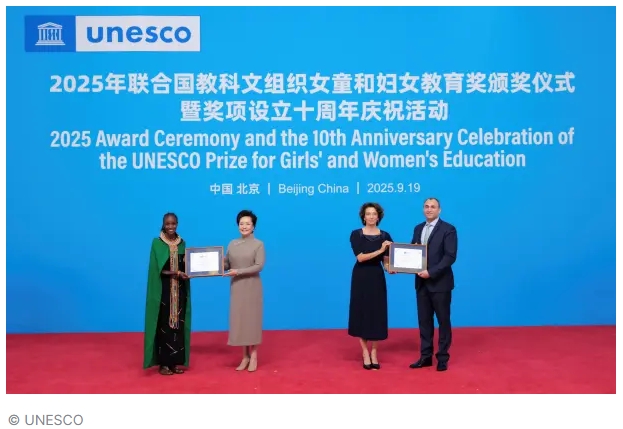
Audrey Azoulay, Director-General of UNESCO and Professor Peng Liyuan, Special Envoy of the Organization, celebrated on Friday the 10th anniversary of the UNESCO Prize for Girls' and Women's Education, supported by China. During her visit, the Director-General will also sign key agreements for the establishment of a new UNESCO Institute in Shanghai dedicated to science and technology education – a field in which women remain underrepresented.
Gender equality in education, a global priority for UNESCO
Over the past 30 years, the enrollment rate for girls in primary education has increased by 8 points, from 92% to near universal enrollment worldwide and for secondary education by more than 25 points, from 52% to 77%. In higher education, the number of female students has tripled, from 41 million to 139 million. To achieve such progress, UNESCO supports its Member States in implementing dedicated public policies – 44 of them received such support in 2024.
However, 133 million girls worldwide are still out of school due to lack of funding, persistent gender bias, or even regressive policies. This is particularly the case in Afghanistan, the only country in the world where secondary and higher education is prohibited for girls, depriving more than 2.2 million of them of an education.
Other inequalities persist, particularly in Science, Technology, Engineering and Mathematics (STEM), where women still account for only 35% of graduates. In 2024, UNESCO helped 17 countries lower the barriers that deter girls from pursuing these fields, through mentoring programs and teacher training.
During her visit to China, Audrey Azoulay will also visit the future UNESCO International Institute for STEM Education, in Shanghai, which will strengthen our support to countries in these key disciplines and among other missions, encourage young women to pursue careers in these innovative fields.
The UNESCO Prize for Girls' and Women's Education
The UNESCO Prize for Girls' and Women's Education, established in 2015 with the support of China, also reflects UNESCO's commitment to promoting gender equality and encouraging fair and sustainable access to education for women. In 10 years, the Prize has recognized 20 laureates whose initiatives support millions of girls and women in all regions of the world. Each laureate receives a grant of $50,000 to continue their work in support of girls' and women's education. Two outstanding initiatives, from Kenya and Lebanon, were selected by the jury this year from a record number of nominations.
Nashipai Maasai Community Projects (Kenya): Supporting the education of Maasai girls and the defense of their rights
Founded in 2015, this initiative led by women and young people supports the education of Maasai girls in Kenya by offering them scholarships and working with communities to combat child marriage and gender stereotypes that limit girls' potential. Through community dialogue, advocacy and food security initiatives, Nashipai has enabled more than 3,000 girls to complete their schooling and pursue higher education, thereby forming a new generation of leaders for gender equality.
All Girls Code (Lebanon): Developing leadership and vocations for girls in digital fields
Founded in 2017 by two young Lebanese women, this initiative enables girls in Lebanon and across the Arab region to acquire skills in coding, technology and leadership. Led by young people and run by volunteers, this programme offers free training and mentoring programmes, which particularly benefit disadvantaged communities and refugees. More than 2,500 girls in nine countries have already benefited from these initiatives, opening up educational and career opportunities for them.
UNESCO's action in the field of gender equality in education
Gender equality is a global priority at UNESCO. Globally, 133 million girls and 139 million boys are out of school. Women still account for almost two-thirds of all adults unable to read.
UNESCO calls for attention to gender equality throughout the education system in relation to access, content, teaching and learning context and practices, learning outcomes, and life and work opportunities. The UNESCO Strategy for gender equality in and through education (2019-2025) focuses on a system-wide transformation to benefit all learners equally in three key areas: better data to inform action, better legal and policy frameworks to advance rights and better teaching and learning practices to empower.
----This article is reprinted from the official website of UNESCO
