

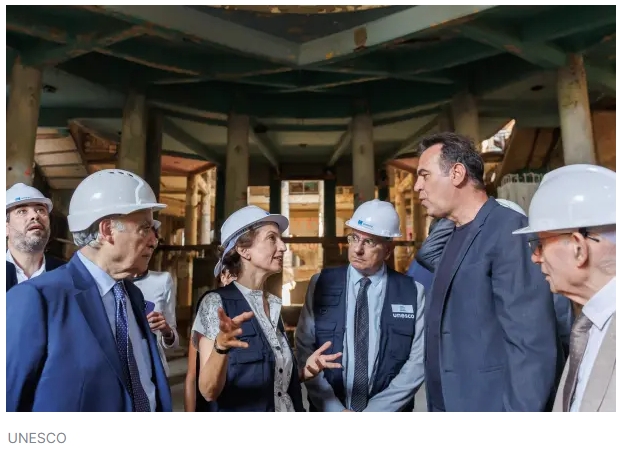
Five years after the port explosions, Audrey Azoulay visited Beirut to take stock of the major work carried out by UNESCO. During her visit, the Director-General unveiled the new programmes to be rolled out by the Organization, including the reconstruction of Mar Mikhael train station and the Grand Theatre, as well as support for the cultural industries in Tyre and Baalbek.
Major works to serve Lebanese culture
Among the initiatives presented during her visit, the Director-General laid the foundation stone for the renovation of the Mar Mikhael train station. Once connecting three continents, this iconic space of over 10,000 m², now in ruins, will be transformed by UNESCO and UN-Habitat into a cultural and living space for the inhabitants of the capital. With $3.5 million funding by Italy, this new cultural space will open its doors in 2027.
Another symbol of Beirut's cultural landscape, the Grand Theatre, closed since 1990 and damaged in 2020, will be the subject of an ambitious restoration project. The first phase’s funding of $1 million by the United Arab Emirates will stabilize the building and develop a cultural project in consultation with the municipality, the Ministry of Culture and civil society. During her visit, Audrey Azoulay called on new donors to join the initiative.
Finally, in Tyre and Baalbek, Phoenician cities listed as World Heritage sites, UNESCO will support local cultural and creative industries by funding seven artistic and craft projects.
LiBeirut: a historic urban rehabilitation operation
Launched by Audrey Azoulay in the aftermath of the port explosions, the LiBeirut initiative has mobilized more than $45 million to support the reconstruction of the capital. The Organization coordinated the rehabilitation of 280 educational establishments, enabling thousands of children to return to school. It also provided equipment to 126 public schools and trained more than 1,000 teachers in hybrid teaching.
In the cultural sector, UNESCO supported more than a thousand cultural professionals, artists, festivals and institutions. The Sursock Museum, a symbol of Beirut's cultural life, reopened in May 2023 thanks to the Organization's efforts. The Sursock Palace continues to receive support on the stabilization of its historic ceilings, and in training young heritage specialists.
A rapid and effective response to hostilities in the region
Since the start of the regional crisis in October 2023, UNESCO has mobilized nearly $1 million to support the cultural and educational sectors in Lebanon. The expertise acquired since 2020 has enabled the rapid deployment of an emergency plan on the ground.
The Organization has deployed damage assessment and technical support missions to several damaged Lebanese cultural sites, including those in Tyre and Baalbek. In order to ensure the safe transfer and protection of priceless artworks, storage and digitization equipment has been provided to the Directorate General of Antiquities.
In the education sector, more than one million young people have benefited from psychosocial support programmes and therapeutic artistic activities. UNESCO has rolled-out a national programme to re-start learning in around 100 schools across Lebanon.
----This article is reprinted from the official website of UNESCO
